History 01 Fire to Fibre · 13 eras · one race against time

From fire to fibre.

For most of history a message moved as fast as a horse. Scroll the race: one track, replayed in thirteen eras, while the wait falls from days to milliseconds.

Time for one message, era by era9 days to 22 ms

    Log scale: every grid line down is a far bigger jump than it looks. Hollow points mean under a second.

    01
    The race

    Same track, every era.

    Every replay runs left to right on the same track. The routes are real and change from era to era, so each time says what was measured and over what distance. Replays are sped up or slowed down so you can watch them; the clock always shows real time.

    5th c. BCRelay riders · Persia

    Fresh horses, every day.

    The Persian kings built relay stations a day's ride apart, each with fresh horses and riders waiting. A message ran from Susa to Sardis, about 2,700 km, in about 9 days. On foot it took about 90. Herodotus wrote that neither snow nor rain stopped these couriers.

    Susa to Sardis · about 2,700 kmReplay
    Susarider on footSardis
    Elapsed0 d

    Timeabout 9 days
    Distanceabout 2,700 km
    On footabout 90 days
    For comparison

    Rome was no quicker. In AD 193 news that Pertinax had become emperor took over 63 days to reach Egypt.
    9th c.Beacon chain · Byzantium

    A fire you could read.

    Under Emperor Theophilos (829 to 842), Leo the Mathematician is credited with a chain of bonfires over about 720 km, from Loulon in Cilicia to the Great Palace in Constantinople. Matching water clocks stood at both ends, and the hour the fire was lit picked one of 12 messages agreed in advance. Modern experiments suggest it crossed Asia Minor in about an hour.

    Loulon to Constantinople · about 720 kmReplay
    LoulonLit at hour 3 · Read: waitingGreat Palace

    Each of the 12 hours stood for one message agreed in advance. Pick the hour, light the chain, and the palace reads the message from the hour on its own clock.

    Light at
    Hour 3
    Elapsed0 min

    Timeabout 1 hour
    Distanceabout 720 km
    Vocabulary12 messages
    The catch

    Fire is fast but says almost nothing. The chain could carry only the 12 messages agreed in advance, and only one at a time. Anything new still went by rider.

    1794Optical telegraph · France

    Arms that talk.

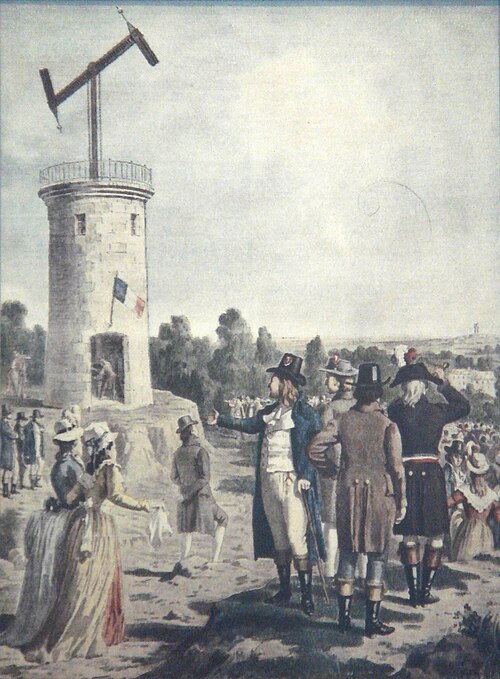
    Chappe's towers carried a beam with two movable arms, and each position meant a symbol. On the Paris to Lille line, 22 stations passed a symbol 230 km in about 2 minutes. In 1794 news of the capture of Condé-sur-l'Escaut arrived in under an hour. The network grew to 556 stations over 4,800 km.

    Paris to Lille · 230 km · 22 stationsReplay
    Pariseach tower copies its neighbourLille
    Elapsed0 s

    Timeabout 2 min
    Distance230 km
    Rate2 to 3 symbols a minute
    A crowd watches a Chappe semaphore tower with its signalling arms raised
    A Chappe semaphore tower, in a later illustration.Public domain, via Wikimedia Commons
    1844Electric telegraph

    Lightning on a wire.

    On 24 May 1844 Samuel Morse sent "What hath God wrought" about 38 miles, from the Supreme Court chamber in the US Capitol to Baltimore. The pulse itself crossed in under a second. From now on, the slow part was the hand on the key.

    Washington to Baltimore · about 38 milesReal time
    US Capitolshown in International Morse, a later standardBaltimore
    Keyed0.0 s

    On the wireunder 1 s
    Distanceabout 38 miles
    New limitthe operator
    Faster than a train

    In Britain, Cooke and Wheatstone patented their telegraph in 1837 and opened the first commercial line, 13 miles from Paddington to West Drayton, in 1838. In 1845 it caught John Tawell, a murderer who had fled by train: the message outran him.

    1858First Atlantic cable

    The ocean pushes back.

    Completed on 5 August 1858, the first cable under the Atlantic worked for about three weeks. Queen Victoria's message of 98 words took 16 hours to get through. Watch the clock go back up: fast on land did not yet mean fast under the sea.

    Across the Atlantic · 98 wordsReplay
    Europe0 of 98 wordsNorth America
    Elapsed0 h

    Time16 hours
    Message98 words
    Working lifeabout 3 weeks
    A step backwards

    A pulse on a 38-mile land line arrived in under a second. Under the ocean, the first cable was so slow that a short royal message took most of a day.

    1866Atlantic cable · Great Eastern

    Eighty times faster.

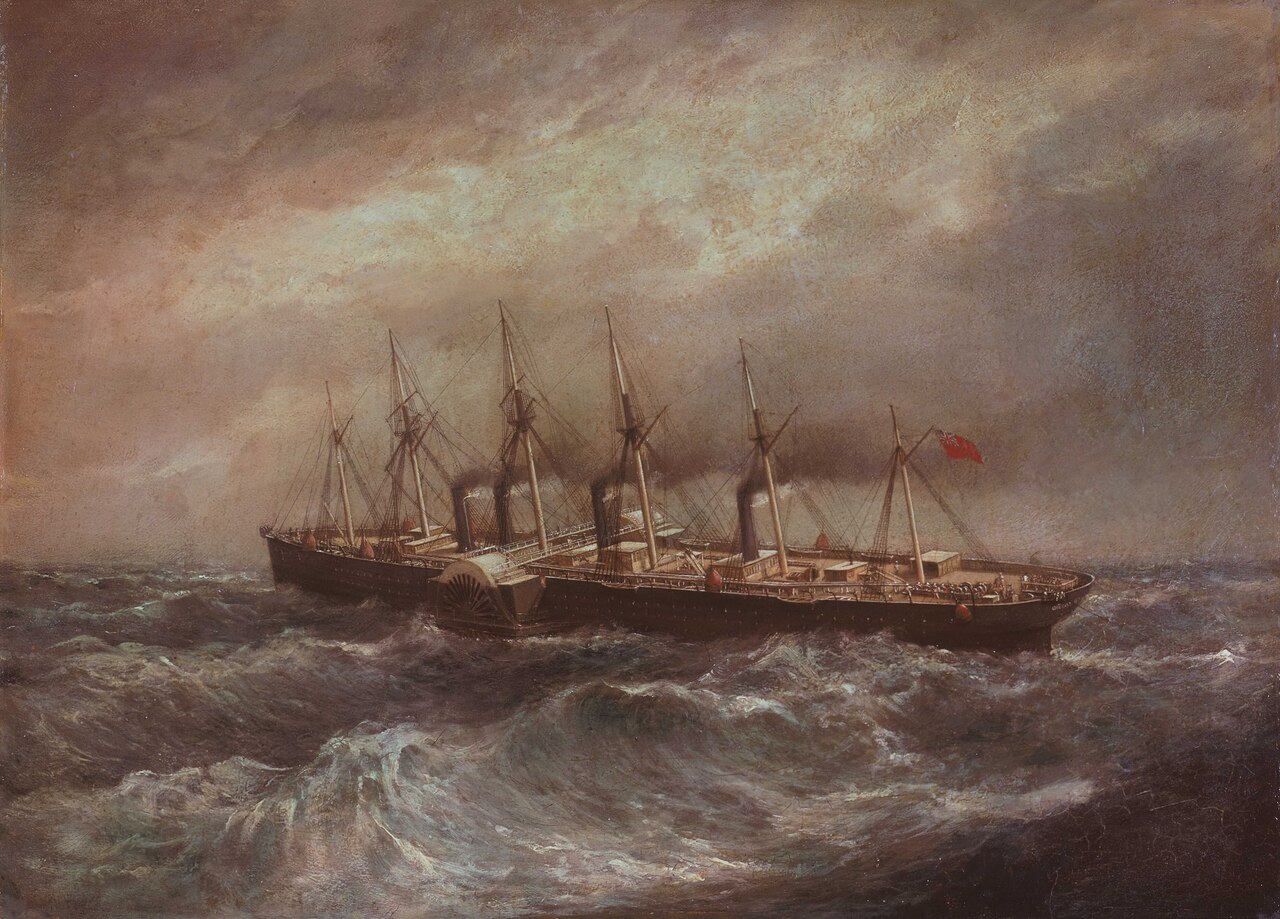
    The Great Eastern laid a new cable, landed at Heart's Content, Newfoundland, on 27 July 1866. It carried 8 words a minute, about 80 times the 1858 cable. At that rate the Queen's 98 words take about 12 minutes. It was not cheap: 20 words cost £20, about $100 in gold, roughly ten weeks' wages for a skilled worker.

    To Heart's Content · the same 98 words, two cablesReplay
    Europe1866: 0/98 1858: 0/98Heart's Content
    Elapsed0 s

    98 wordsabout 12 min
    Rate8 words a minute
    20 words£20
    The steamship Great Eastern in a heavy sea while laying the Atlantic cable
    The Great Eastern laying the first successful Atlantic cable.Royal Museums Greenwich, BHC3380. Public domain, via Wikimedia Commons
    Then the world

    On 23 June 1870 a cable from Porthcurno through Gibraltar, Malta, Alexandria, Suez and Aden reached Bombay. A reply from India came back in minutes, not the six weeks the mail took. By 1933 telex machines in Germany typed about 66 words a minute.

    1876Telephone

    Now the wire speaks.

    Bell's patent, US 174,465, was filed on 14 February and granted on 7 March 1876. Three days later came the first words: "Mr. Watson, come here, I want to see you." No code, no clerk: you simply talked, and the other end heard you as you spoke.

    Bell to Watson · one wireReal time
    Bell21 lines below: New Haven, 1878Watson
    Delaylive

    Delaylive
    First exchange21 subscribers
    Price$1.50 a month
    The exchange

    On 28 January 1878 New Haven, Connecticut opened the first commercial telephone exchange. Its 21 subscribers paid $1.50 a month, and an operator joined the calls by hand.

    1901Radio · Marconi

    No wire at all.

    On 12 December 1901 Guglielmo Marconi reported hearing the Morse letter S, three short dots, sent from Poldhu in Cornwall to Signal Hill in Newfoundland, about 3,500 km across the Atlantic. Whether he truly heard it is still debated. The idea stuck anyway: a message could cross an ocean through the air.

    Poldhu to Signal Hill · about 3,500 kmSlowed for viewing
    Poldhuheard: · · · (reportedly)Signal Hill
    Through the airunder 1 s

    Timeunder 1 s
    Distanceabout 3,500 km
    Statusreported, debated
    Read with care

    The reception is a reported claim that historians still debate, so the dots arrive faintly here on purpose.

    1956TAT-1 · Telephone cable

    Voices under the ocean.

    On 25 September 1956 TAT-1 opened between Oban in Scotland and Clarenville in Newfoundland: the first telephone cable across the Atlantic. It carried 35 calls at once. On its first day, 588 calls went between London and the US. Three minutes cost $12, or $9 off-peak.

    Oban to Clarenville · 35 channelsReplay
    Oban3 minutes: $12 · off-peak $9Clarenville
    Day one0 calls

    Delaylive
    At once35 calls
    Day one588 calls
    Now the race is capacity

    By now the signal itself was close to instant. The question became how many conversations fit on one line, and what each one cost.

    1962Satellites · Telstar, Early Bird

    Bounce it off the sky.

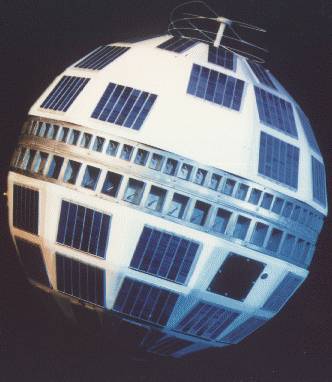
    Telstar 1, launched on 10 July 1962, carried the first live public TV across the Atlantic on 23 July. But it kept moving: each orbit took about 2.5 hours, and the link worked for only about 30 minutes of it. On 6 April 1965 Intelsat I, "Early Bird", the first commercial geostationary satellite, stayed in one place in the sky.

    Telstar 1 · usable about 30 min per orbitReplay
    EuropeTelstar is below the horizonNorth America
    Waited0 min

    Windowabout 30 min
    Per orbitabout 2.5 hours
    Early Bird149 kg, always up
    The Telstar satellite, a sphere covered in solar panels
    Telstar 1, which carried the first live public TV across the Atlantic.NASA. Public domain, via Wikimedia Commons
    1970 · 1988Optical fibre

    Messages made of light.

    In 1970 Corning made glass fibre that lost 17 dB of light per kilometre, where the best glass before lost about 1,000. That turned light into a practical carrier. In 1988 TAT-8 became the first fibre cable across the Atlantic: 280 Mbit/s, about 40,000 circuits.

    One kilometre of glassSlowed
    0 kmLight left: 100%1 km
    In the glass0 µs

    Loss, 197017 dB/km
    Loss beforeabout 1,000 dB/km
    TAT-8, 1988280 Mbit/s
    Why loss matters

    Every 10 dB lost leaves a tenth of the light. At 17 dB a kilometre, about 2% survives the trip. At 1,000 dB, effectively none does. The brightness here is drawn on a compressed scale so you can see the fade.

    TodayFibre under the Atlantic

    New York to London in 28 ms.

    A signal in fibre crosses from New York to London in about 28 milliseconds one way, 56 there and back. A single modern cable, MAREA, carries 200 Tbps. The wait is now set by the speed of light in glass.

    New York to London · and backReal time, then slowed ×100
    New YorkPress send: the first pass is real timeLondon
    Elapsed0 ms

    One wayabout 28 ms
    Round tripabout 56 ms
    MAREA200 Tbps
    The floor

    No new invention makes light faster. From here, shaving time means shorter routes, fewer hops and smarter switching. That is where TDNT works.

    NowTDNT

    The end of the line.

    A call crossing TDNT passes five stages, from ingress to a sealed record, in about 22 ms. Switching inside the core takes under a millisecond.

    Ingress to egress · five stagesSlowed
    Call intimes from the TDNT platform traceCall out
    ElapsedT+0 ms

    Pipelineabout 22 ms
    Switching in the core< 1 ms
    EU to Middle East≈ 60 ms median
    Follow a call

    Each stage has its own budget and its own metrics.

    02
    Where the race ends

    From 9 days to milliseconds.

    Twenty-five centuries, one direction. The rider needed 9 days for 2,700 km. Light in fibre crosses a whole ocean in 28 ms.

    5th c. BC · relay rider 9 days Susa to Sardis, about 2,700 km
    Today · fibre 28 ms New York to London, across an ocean

    About 28 million times less waiting, for a longer trip.

    • ≈ 60 msMedian round trip, EU to Middle East
    • ~22 msA call across TDNT's five stages
    • < 1.6 sMedian post-dial delay on voice
    • < 1 msSwitching inside the core
    • 240+Direct carrier interconnects
    • 190Destinations

    Your message, the fast way.

    Riders, fires, wires and light all led here. See the network a call crosses today, or pick the service that carries your traffic.

    03
    Sources

    Where the numbers come from.

    Each era's time is the one its source records, for that era's own route. The routes differ, so the track is shared but the distances are not; each time is labelled with what was measured.

    Worked out by us: 98 words at 8 words a minute (about 12 minutes); about 5 µs per kilometre of fibre, from light travelling about 200 km per millisecond in glass; and the 28 million ratio (9 days over 28 ms). Replay speeds, the Telstar waiting time and the Morse keying pace are part of the animation, not history.

    1. Byzantine beacon system. Wikipedia
    2. Chapar Khaneh, the Persian relay stations. Wikipedia
    3. Cursus publicus and the news of Pertinax. Wikipedia
    4. Semaphore line, Chappe's Paris to Lille line. Wikipedia
    5. Cooke and Wheatstone telegraph, and John Tawell. Wikipedia
    6. Morse's telegraph in the Capitol. United States Senate
    7. Transatlantic telegraph cable, 1858. Wikipedia
    8. Atlantic cable services and tariffs, 1866. atlantic-cable.com
    9. The 1870 cable to India. Greenwich Industrial History
    10. Invention of the telephone. Wikipedia
    11. The first commercial telephone exchange, New Haven. ConnecticutHistory.org
    12. Guglielmo Marconi and the 1901 signal. Wikipedia
    13. Telex. Wikipedia
    14. TAT-1. Wikipedia
    15. Telstar. Wikipedia
    16. Intelsat I, Early Bird. Wikipedia
    17. World's first low-loss optical fibre, 1970. ETHW
    18. TAT-8. Wikipedia
    19. Primer on latency and bandwidth, New York to London. High Performance Browser Networking
    20. MAREA reaches 200 Tbps. Submarine Networks
    21. TDNT figures: Network page.
    22. Images: Chappe semaphore illustration; the Great Eastern, Royal Museums Greenwich BHC3380; Telstar, NASA. All public domain, via Wikimedia Commons.
    More from TDNT history