History 02 The Switchboard · routing, 1878 to now

Put the call through.

Every call has to be routed. In 1878 a person did it with a cord. Today TDNT's software chooses among 240+ carriers in milliseconds. Work the board, send a message of your own, then steer today's routing.

01
Act 1 · 1878

You are the operator.

A drop falls, a jack lights up, someone wants to talk. Drag a cord from the lit jack to the line they asked for. Or tap one jack, then the other. Calls come faster as the shift goes on.

Manual switchboard · simulated calls, invented names Waiting for the operator
Connected0
Missed0
Wrong line0
Avg to connect-
New call every-
Calls waiting 0

    Quiet board. Enjoy it while it lasts.

    1878 · New Haven style

    Your shift starts now.

    When a jack lights up, connect it to the line the caller asked for. Drag the cord, or tap the two jacks. Keyboard: Enter on the ringing jack, then Enter on its target.

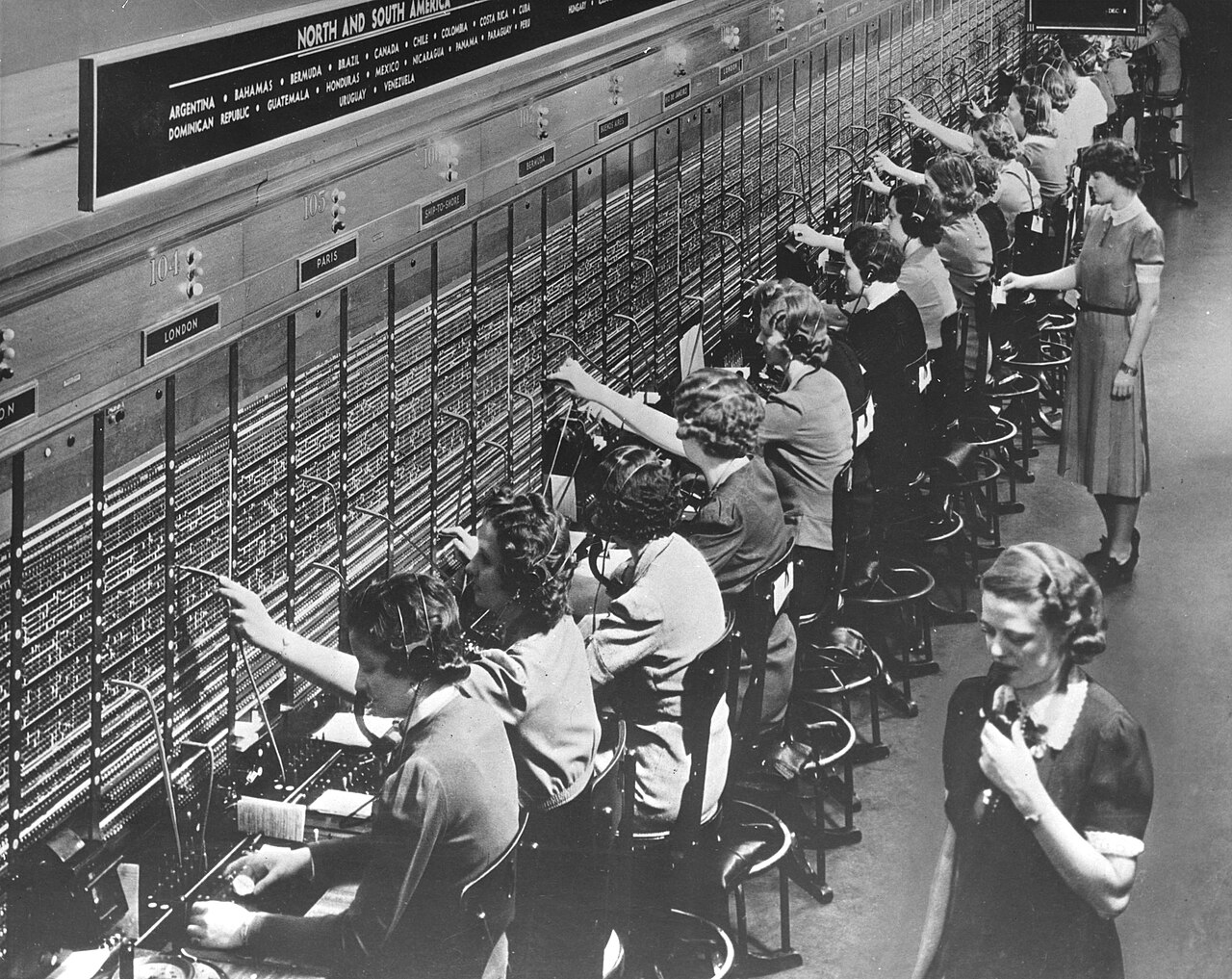
    A long row of telephone operators in headsets plugging cords into a tall switchboard labelled London and Paris.
    Bell System operators at a switchboard for overseas calls, 1943. Sixty-five years after New Haven, routing still ran on people and cords.Photo: US National Archives, public domain, via Wikimedia Commons
    1876 · the first call

    Alexander Graham Bell's telephone patent, US 174,465, was granted on 7 March 1876. Three days later came the first call: “Mr. Watson, come here, I want to see you.” Once many people had phones, someone had to decide which line met which.

    28 Jan 1878 · New Haven, Connecticut

    The first commercial telephone exchange opened with a switchboard George Coy built from carriage bolts and the handles of teapot lids. It served 21 subscribers at $1.50 a month. The first directory, in February, listed 50 names.

    1 Sep 1878 · Boston

    Emma Nutt became the first female telephone operator: $10 a month for a 54-hour week. She reportedly remembered every number in the directory. Women replaced the teenage boys exchanges had hired first, who swore and played pranks.

    ExchangeNew Haven
    Subscribers21
    Monthly fee$1.50
    RouterA person
    02
    Act 2 · Today

    Your own line.

    Every visitor to this site gets a line. Give yours to a friend, dial theirs, and send one message a day by the method of your choice. They watch it arrive on whatever TDNT page they have open.

    TDNT line · browser to browser, nothing stored Connecting
    Enter a code
    0 / 160
    Send it by

    03
    Act 3 · Today

    Software picks the route.

    Each call into TDNT is scored against the carriers that can reach it, on cost, MOS (voice quality), ASR (answer rate) and ACD (call length). The best route wins in milliseconds. Set the priorities and watch the choice change.

    Live routing view · simulated traffic, real rules Routing

    Six of our 240+ direct interconnects, with simulated figures. Ember marks a retry or a failover.

    Your priorities
    Calls routed0
    Avg cost / min-
    Avg MOS-
    Fallback retries0
    Failovers0
    Carrier$/minMOSASRACDScoreStatus

    Floor: MOS 4.0. Carriers below it are skipped automatically.

    In the demo the ranking refreshes every two seconds so you can watch it move. In production it refreshes every five minutes, on measured traffic.

    04
    What changed

    From cords to code.

    The job never changed: find the right line, fast. What changed is who does it, how many choices there are, and how quickly the choice is made.

    1878 · operator
    Who routesA person
    ChoicesOne board
    Decides byMemory
    1892 · Strowger
    Who routesYour dial
    Choices100 lines
    Decides byPulses
    1956 · TAT-1
    Across the Atlantic35 calls at once
    A 3-minute call$12
    Today, at our edge180k legs
    Today · TDNT
    Who routesSoftware
    Choices240+ carriers
    Decides byCost, MOS, ASR, ACD

    Route your traffic through it.

    The routing you just steered runs inside our wholesale voice network. See how it balances carriers, or explore the network it runs on.

    Sources
    1. Invention of the telephone: Bell's patent US 174,465 and the first call, 10 March 1876. Wikipedia
    2. The first commercial telephone exchange, New Haven, 28 January 1878. ConnecticutHistory.org
    3. Emma Nutt, first female telephone operator, Boston, 1878. Wikipedia
    4. Almon Strowger, the automatic exchange and La Porte, Indiana. Wikipedia
    5. Almon B. Strowger, the undertaker who revolutionized telephone technology. SPARK Museum
    6. TAT-1, the first transatlantic telephone cable, 1956. Wikipedia
    7. RFC 3261, SIP: Session Initiation Protocol, the signalling behind modern voice cores. RFC Editor
    8. Photograph of women working at a Bell System telephone switchboard, 1943. US National Archives, public domain. Wikimedia Commons
    9. TDNT figures: Network and Wholesale voice.

    Names, numbers and carrier figures inside the operator and routing demos are simulated. Messages sent in Act 2 are real, passed browser to browser and never stored.

    More from TDNT history